
Agency across languages
Agency across languages
We act to create and make choices, individually and collectively.
An important part of these actions and choices shaping the world we share, as well as our inner world, takes place in language.
But there are as many languages as there are populations and worldviews encoding the lived experience.
The main goal (communication) is the same. But the roads are different.
If you and I articulate our thoughts about the same object in different languages, the tokens we refer to are different, the lived experience they refer to are, to a degree, different and the cultural context they refer to are also different, even when they refer to the same reality.
“The map is not the territory”. But the map still guarantees that your thoughts are encoded in a way that makes sense to others.
Inner maps and inner roads are one thing. We all have a natural relationship with our language. But what about relationships between languages?
That’s what translation deals with, and it starts with understanding the object from the different perspectives and the different contexts behind the object we refer to.
Then, and only then, can human choice make a difference when paving roads from one language to the other.
Organic, synthetic or hybrid roads: which is the right one?
I can’t help but draw parallels between self-driving cars and automation in languages.
Going from point A to point B is, in terms of data points, feasible for modern machines.
But you can’t (or you shouldn’t) automate what hasn’t been safely approved by human pathways. Both in roads and in language. Unless you want to take the risk of going off a cliff.
While experts in the AI field and tech lords debate extinction probability rates, I believe that we can start by analysing what hyper efficient automation means for every aspect of life and for every industry so we can choose automation processes wisely.
This article aims to provide that analysis from the perspective of translation practices, drawing parallels with the automation of code and describing the landscape ahead. Finally, there will be recommendations for implementation, specifically aimed at online creators and specialists interested in new expansion possibilities beyond their English borders.
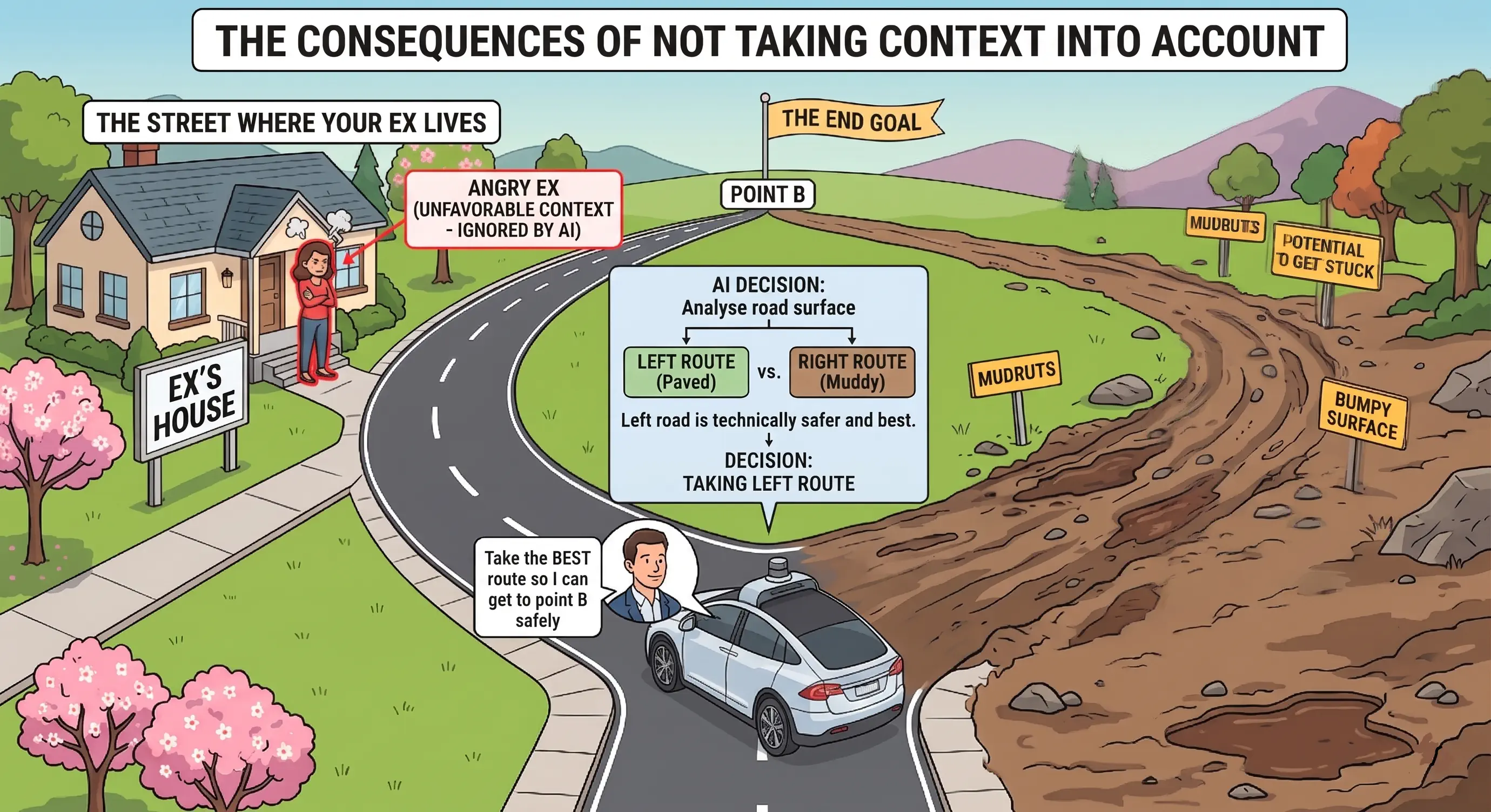
The widespread use of LLMs for immediate text generation and subsequent tasks around it (summary, reformulation, synthesis, stylistic improvement, and of course, translation) is a particularly tricky area.
LLMs are, by far, the best technology for language processing, but they operate exclusively within the symbolic realm.
They can unfold through next token prediction every possible word/token sequence, and make sense of the output by calculating data point relations.
In a way, we do exactly the same: our mind predicts the next word and we keep building on the designated pathway. For example, if we greet someone, we go “hello>how>are>you?” or a similar variation without thinking about it too much. The pathway is already built in a context that’s been forged by countless experiences and uses.
Our tokens have been coined collectively throughout history and are individually consolidated in our dataset through intentional and contextualised encoding. In other words, language emerges within us through a coherent and continuous relationship with the world.
AI works like a generalised and detached representation of tokens following the general consensus of our data. This is why it can be used efficiently to connect the dots at a large scale by sheer computing power and make math and drug discoveries.
However, in high-stakes fields, caution is necessary for obvious reasons: risks of bioweapons, cybersecurity issues or economic disruption, to name just a few consequences.
But most people seem to be ok with AI automation in other areas, as long as they are not a matter of life or death. Code and language-related tasks are the clearest examples, of course.
An important question regarding these two fields of expertise is whether we should automate them, but an even more relevant question is “do we know what we should and we shouldn’t automate, and why?

Neo and Trinity needed guns. Lots of guns. Still, they had to made specific choices tailored to the specific needs of their mission, and more importantly, to their capacity and skills. The right choices in the armory are vital, and so are the ones you make for the Spanish version of your text.
Technology enables the acceleration and simplification of physical and cognitive tasks, but it doesn’t provide the judgment and discernment to back decisions centered in human complexity.
Sure, they can help and be extremely useful, and this new wave of innovations will end up alleviating work as we know it today, but the jump in capabilities is so huge that we are urged to assess these new and highly accessible delegations in every field of expertise.
We need to rethink safe and coherent ways of automation to understand hybridation processes in the long term and guarantee the interpretability of outputs and results. Otherwise, we shall be at the mercy of indefatigable machines and algorithms defining what’s right for us.
We’re still in the early age of AI, and it has been both incredible and a complete mess. An example of this duality is visible for professional translators and developers. Some of them are hyped, but most are freaking out for a variety of justified reasons.
The main reason is, obviously, that the general public ignores how language and code work are carried out.
The first quality both disciplines take into account is supervised intention. What needs to be done, why, with what and for whom. These are, deontologically speaking, the guidelines from which developers and translators do their work.
Automation itself has never been the problem. Github repos, code libraries, computer-assisted translation tools, Google Translate… Automation has always been part of the landscape. But it doesn’t have anything to do with human-to-human contextualised choices.
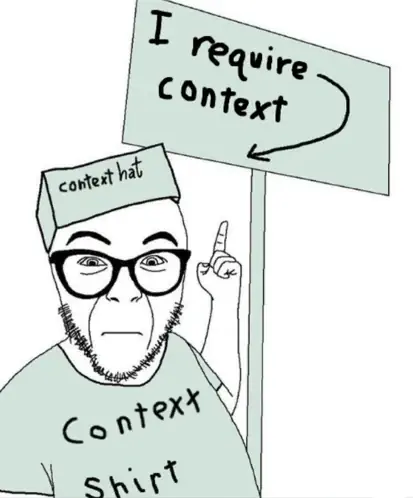
You want me to translate that excellent piece of writing in Spanish? I need context. Your context, not the statistically likely one easily retrievable on the web.
Context isn’t exclusively about polishing an output. It works like a space provided by previous validations where the agent can make informed choices to guarantee that the initial goal is met at the end.
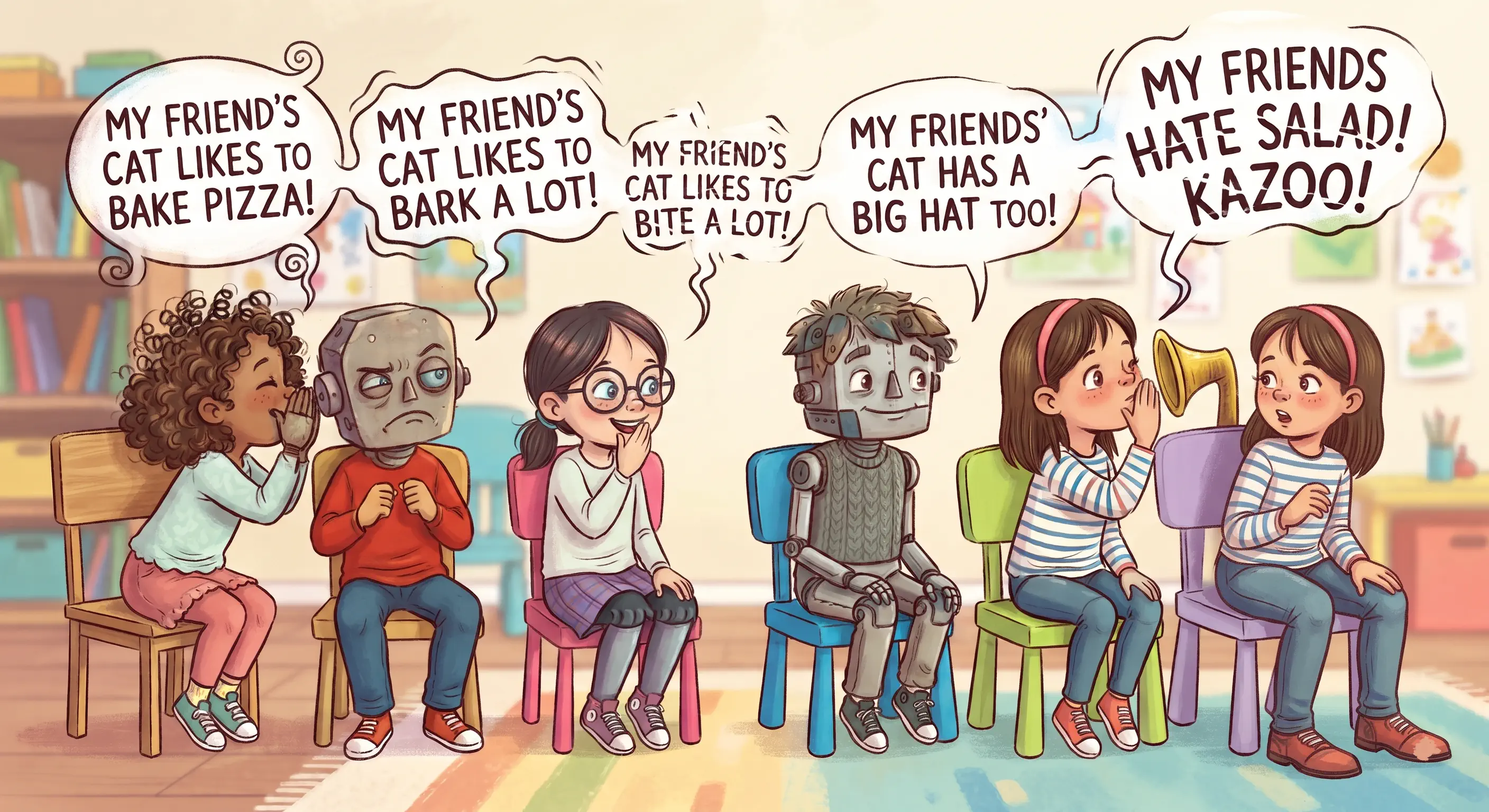
In the telephone game, you must act quickly, you can’t ask for context and you have to guess by statistical probability according to “what the utterance sounded like”. It doesn’t matter if it doesn’t make sense. The output must be provided. Luckily, you can still ask for context in human collaborations to make sure that the end result makes sense to your reader in a different language.
LLMs can be instructed to integrate context with prompts, agents, documentation or any type of data and, as far as I can see, it does a great job in a variety of supervised tasks. But ontologically speaking, they can't ask the same questions as a human.
They don't have access to the same reality, and their language processing is self-referential and not embodied, which means that they can't contextualize or justify choices based on observable variables in a real situation.
In translation, the pattern-oriented treatment of textual context without a previous negotiation leads to a cold, result-oriented calculation.
But paradoxically, the solution you’re looking for lives already within the LLM due to its structural functioning. But how do you know if that solution is the right choice?
The answer isn’t straightforward. If you take a look at the work of professional translators, you’ll see that, beyond the computer-assisted tools with translation memories, regular expressions, QA and glossaries, the gist of what they do lies within their agency across languages.
You can call it linguistic, cultural, or cognitive agency, depending on the required perspective. The common factor is, however, the relationship established between both languages.
Every book you’ve read, every film you’ve watched or any type of documentation that you have had the privilege to learn from but was originally written in another language, especially before AI, was translated by human beings.
Assuming that it was because we didn’t have access to language models would be a mistake. The real value of human translation has never been in “language calculations”, but rather in the restitution of meaning, whether they use technology or not.
AI hype makes us miss the wood for the trees. But that’s the case for many industries and usages, anyway. Translation and multilingual work in general fall under the same category of practices as writing and knowledge work, and in today’s world, it is not different from the three types of value production related to modern technology: “brain-made”, synthetic and hybrid.
“Brain-made” translation is pure brain muscle and paper in action. Perhaps with minimum internet access, but mostly steered by human cognitive effort. It is slow and process-oriented.
Synthetic translation is entirely performed by the machine without human interference, apart from initial instructions. It is almost immediate and result-oriented.
Hybrid translation is similar to modern translation workflows, but with a particularity: the machine is equipped with a phenomenological audit and highlights terminological choices that require human intervention through customised tools.
In any case, hybrid translation is still a matter of agency across languages. Choice, preference, hierarchy, intention and targeted intervention are still guided by the human contextualising his or her interpretation and participatory knowledge of the world to work on a text that goes from one language to the other.
As a professional translator, I have tried all of them and I have adapted my choices for each task. As I said, it’s all about context.
For example, when it comes to personal essais that have been entirely written by English or French thinkers, like the ones you read on Substack, I do, for the most part, slow translation with a bit of hybridation for clarity. This decision is mostly because I enjoy the process of preserving the depth and authenticity of writers with a mission.
(I’m not sure if I am biased by Theory of Mind, but I feel that humans are better than machines at tuning into other humans’ text when there is a mission behind).
When I work on scientific domains (mostly cognitive sciences, deeptech and biotech), I automate the most predictable chunks within a hybrid workflow carefully supervised. Of course, it all depends on the documentation and intended reader.
In any case, I am always moving intentionally and deontologically across languages, aware of my human limits and the machine limits.
Speaking of which, my own limitations are visible from a “general public” position when it comes to software development for work and personal uses.
The unity of language and thought is the key to unlock new dimensions with AI. The unity of languages and thought through human agency unlocks the door to minds in other cultures
I started vibe-coding through the lens of a linguist and during the first days, I couldn’t stop thinking about it.
It becomes surprisingly addictive when there is a clear idea of what to build.
I created different small prototypes and the more I created, the more I realised that the limits in the digital space are dictated by imprecise language and goals within the code base.
My maps were exposed. The clarity and depth of my design skills were tested before the absolute vastness of modern LLMs and the output was a product that is incredibly difficult to evaluate from within.
That is also the case for the output that automated functions within such tools produce. And if the output in question turns out to be language-related, you must remember that it’s all a digital feedback loop. The fact that they are called “language models” should remind you at all times that, by nature, their linguistic choices are not the result of a continuous process of interpreting and encoding the same reality you live in.

Most of my initial tools are built like a digital Swiss cheese.
What we need to understand from this is that, no matter how convincing the result provided by current machines is, we still need to make sure that when going from A to B, we have in mind goals as well as a proper trajectory between both, whether the procedure is organic, synthetic or hybrid.
If you want to move with the times, you must position yourself properly according to these three procedures, but most importantly, engage in human collaborations that take these considerations into account.
You don’t need to go back to the stone age.
You don’t need to become a cyborg.
You don’t need to hybridise every single step of the process.
You just need good judgment, a clear goal and the right partner. Preferably, someone who understands what the machine can and cannot do and how the perception of your writing is shaped under the three types of translation workflows into Spanish.
Personally, I am articulating my business around this new reality and I hope I can help English-speaking, mission-driven thinkers, creators and authors establish themselves in a digital market of more than 645 millions, aka the Spanish-speaking market.
If the expansion of your ideas through carefully chosen Spanish words interests you, reply to this newsletter so we can discuss about the project.
Thank you very much for reading.
Hasta pronto,
Javier Arteaga