It’s an incredibly frustrating paradox.
You have spent years mastering Spanish. You consume content about quantum physics, cognitive sciences, or deeptech without breaking a sweat. You know how to argue, abstract, and think critically in a second language.
But then, reality hits. You step out of your intellectual comfort zone into the mundane world. A flight is delayed, and you need to negotiate with the gate agent. You need to explain a specific household repair to a landlord. Suddenly, your brain stalls. You find yourself searching for the most basic, everyday nouns and verbs.
It feels embarrassing. You are a highly capable, articulate adult, yet in these completely ordinary situations, you feel like a stumbling beginner all over again. You are living with a lopsided language skill. A dense, highly capable intellectual core surrounded by surprising, humiliating gaps in the everyday.
You cannot afford to leave these gaps unchecked.
If you continue to ignore your practical vocabulary, the friction between your intellectual capability and your lived reality will only grow. You will find yourself unconsciously avoiding spontaneous, everyday interactions because you dread the mental block.
Instead of fully inhabiting the language, you remain trapped in an ivory tower of complex vocabulary—an eternal spectator in the Spanish-speaking world. Over time, this constant friction erodes your confidence. You risk becoming someone who can write a brilliant essay, but who panics when the waiter asks a simple question about the menu.
The problem is not that your memory is failing you. And the problem is certainly not that you aren't trying hard enough.
The real reason you are struggling with everyday Spanish is that you are using linear, mass-market learning tools for a highly non-linear, advanced mind.
Your cognitive system is already optimized to acquire complex, abstract ideas. When you try to force-feed it random lists of "restaurant vocabulary" or "airport phrases," your brain rejects it because it lacks context and depth. You don’t need flashcards. You need a method that respects your autonomy and maps to how your perception actually functions.
What you really need is to treat your language acquisition not as a rigid list of rules, but as a living structure.
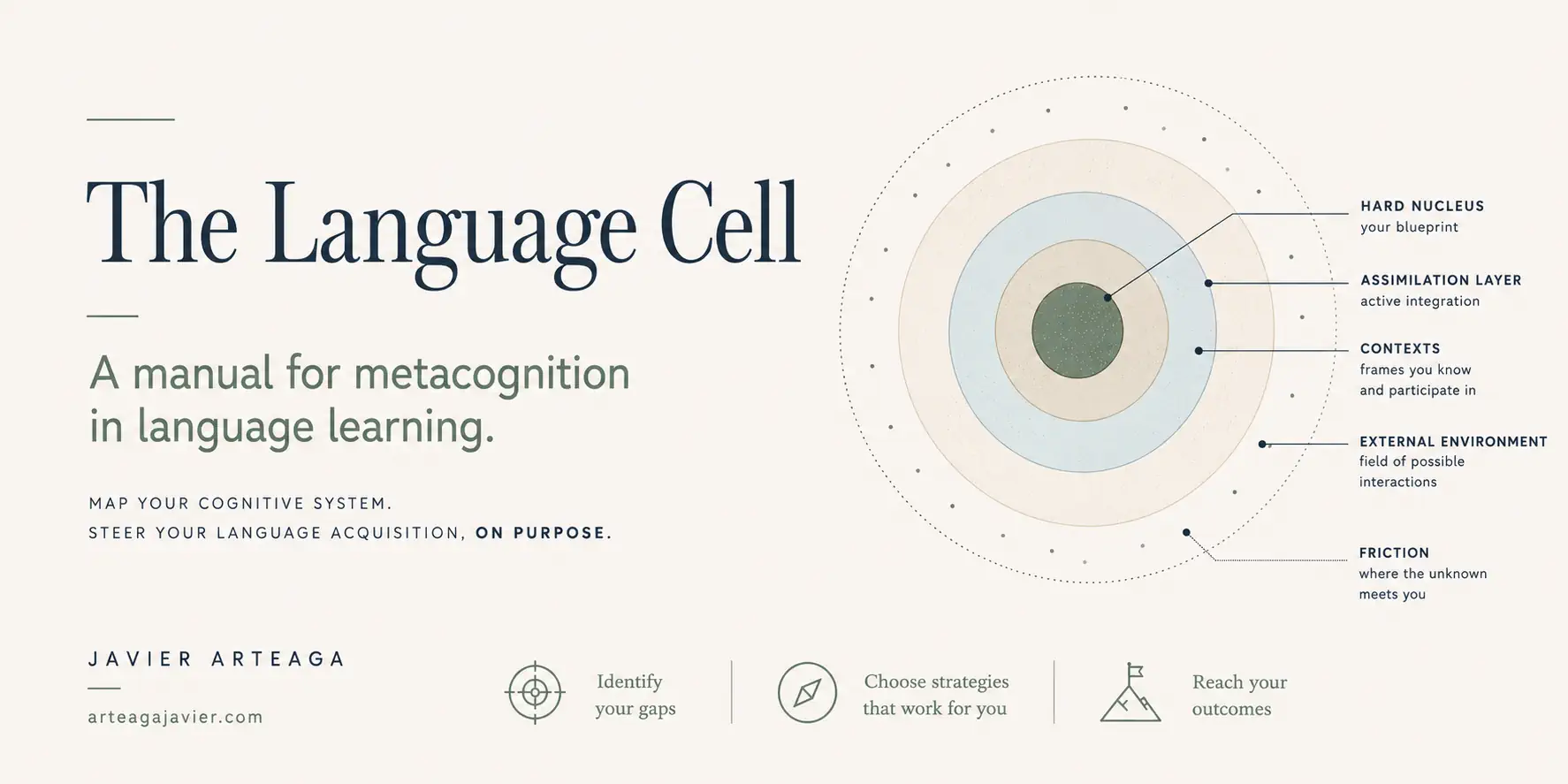
This approach shifts the paradigm. By viewing your Spanish as a living entity—with a hard nucleus of mastered concepts, an active assimilation layer, and an external environment—you can intentionally steer your cognitive system toward the everyday friction you’ve been avoiding.
Instead of rote memorization, you use generative mapping (the Arborescencia method). You take a single mundane object in a context you usually avoid, and you branch it out into dynamic, interconnected actions and new contexts. It works because it takes the same high-level mapping skills you naturally possess and points them directly at your linguistic blind spots. It bridges the agential gap between your mind and the physical world.
You don't need another generic Spanish course. You need a metacognitive instrument.
The Language Cell is a concise, highly practical manual that allows you to map your own cognitive system and steer your Spanish acquisition exactly where it needs to go.
Click here to download The Language Cell and balance your fluency
Will this work if I'm already considered "fluent"? ➔ Yes, in fact, this was built specifically for you. Standard courses abandon you once you reach B2/C1. The Language Cell is designed exclusively for advanced, autonomous learners who have developed a lopsided vocabulary and need to fill practical gaps without going backwards.
Can't I just learn these everyday words for free on an app? ➔ You could try, but standard language apps are built for linear beginners. They strip away context and force you into a gamified loop that your brain will find tedious. This manual saves you hours of frustration by giving you a framework that actually matches your high-level cognitive style.
I've tried making vocabulary lists before, and they never stick. ➔ That is perfectly normal. Isolated lists lack systemic connection. The Arborescencia exercise in this manual forces you to anchor everyday words into dynamic, living contexts, making them impossible to forget.
Is a 15-page manual really worth the investment? ➔ You aren't paying for page count; you are paying for a paradigm shift. In less than an hour, you will self-diagnose gaps that have held you back for years and acquire a custom framework you can use for the rest of your life. It is an immediate return on investment for your confidence.
What if it doesn't resonate with my learning style? ➔ The entire premise of this manual is autonomy. It doesn't force a rigid schedule on you; it gives you the cartography tools to map your own route. If you are an intellectual learner who enjoys systems thinking and deep analysis, this is exactly how your brain wants to learn.